Tuesday, 27 March 2012

The Hair


I built up layers of nettle fibers from the base of the skull up. The fibers were perfect because they had a sort of eerie glow and iridescence that matched the description in the text.

Nosferatu's Wedding Dress


The dress is made from organza, silk chiffon and calico- the combination of materials in similar shades gives the impression of something faded and repaired.

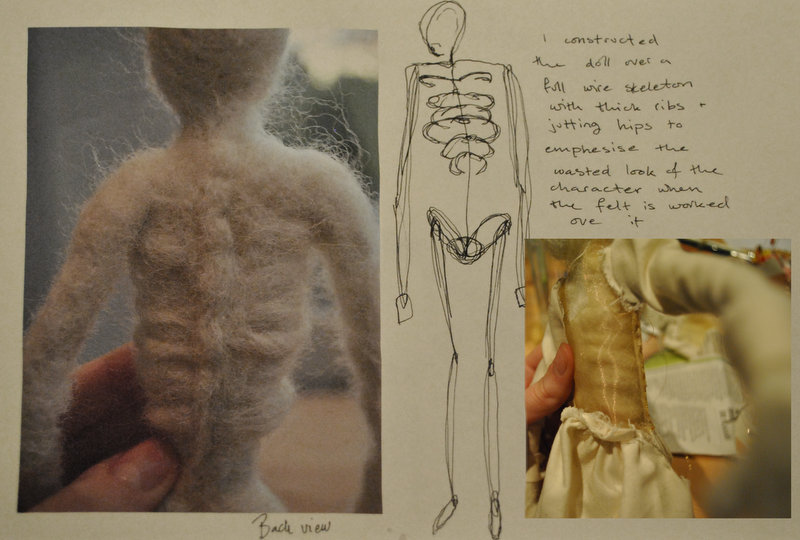
Another approach to needle felt people


My starting point was The Lady of the House of Love by Angela Carter. The story is about Nosferatu, but not
It's the tragedy of a young girl trapped by her ancestors sins and her nature.


 I made up a wire skeleton which included the rib cage and shape of the hip bones rather than the basic structure I used before. This gave the figure a much more emaciated look by allowing the bones to protrude under thin layers of wool.


Nosferatu wears her mothers wedding dress as if it is the only clothes she has. I created a dress that is layered and torn to express the age of the garment. The shape also sits around her like a shell, too big and holding her in.
I hadn't realised how neglected this blog had gotten, I spent so much time on my applications and portfolio the poor this was forgotten about so there will now be a surge of the wonderful images I am now almost sick of looking at.
http://1080451346.blogspot.co.uk/ <-- the more loved (briefly) blog which acted as my Manchester School of Art application

This ended up my favorite page in my portfolio, I had fun with the photography and the challenge of getting an image which showed off all the elements. I'm pleased with the way the focus softened into the background because it brought out some of the whimsy and magic. The little lady bird was pure chance (no, I didn't make it), the little guy wondered out at the right moment and I got the perfect shot. The little men have also taken on a new character because they are now Hobs rather than odd faces. As the commentary will say when they go up in Pannet Park gallery on friday (eeeek):
     Where ever there are people bridging the gap between the natural and man-made world there will be folklore; a way to connect and explain the two worlds and the strange goings on that come with rural living.
Especially common is the story of the magical being which has made it's home alongside people. In Shetland, the Trowie steals babies in the night and replaces them with a changeling for you to unknowingly bring up as your own. In Norway, a Nisse will milk all the cows in the dead of night but leave a patch of ice on the step so your sure to slip on your way in. North Yorkshire's answer to the wee men in the woodshed is the hairy little Hob. Hobs are cheeky, mischievous, naked little men who are both a hindrance and a help to people living on the moors.
I chose this branch of folklore as my inspiration because of the links with the places I call home and because the Hob offers a tie between people, the landscape and a sense of the old world of magic and myth. The felt faces appear from a twist of embroidery expressing the individual character of the Hob, like capturing a glimpse before he disappears again. 

ooo aren't I clever :)

Thursday, 24 November 2011

Faces in the Mist


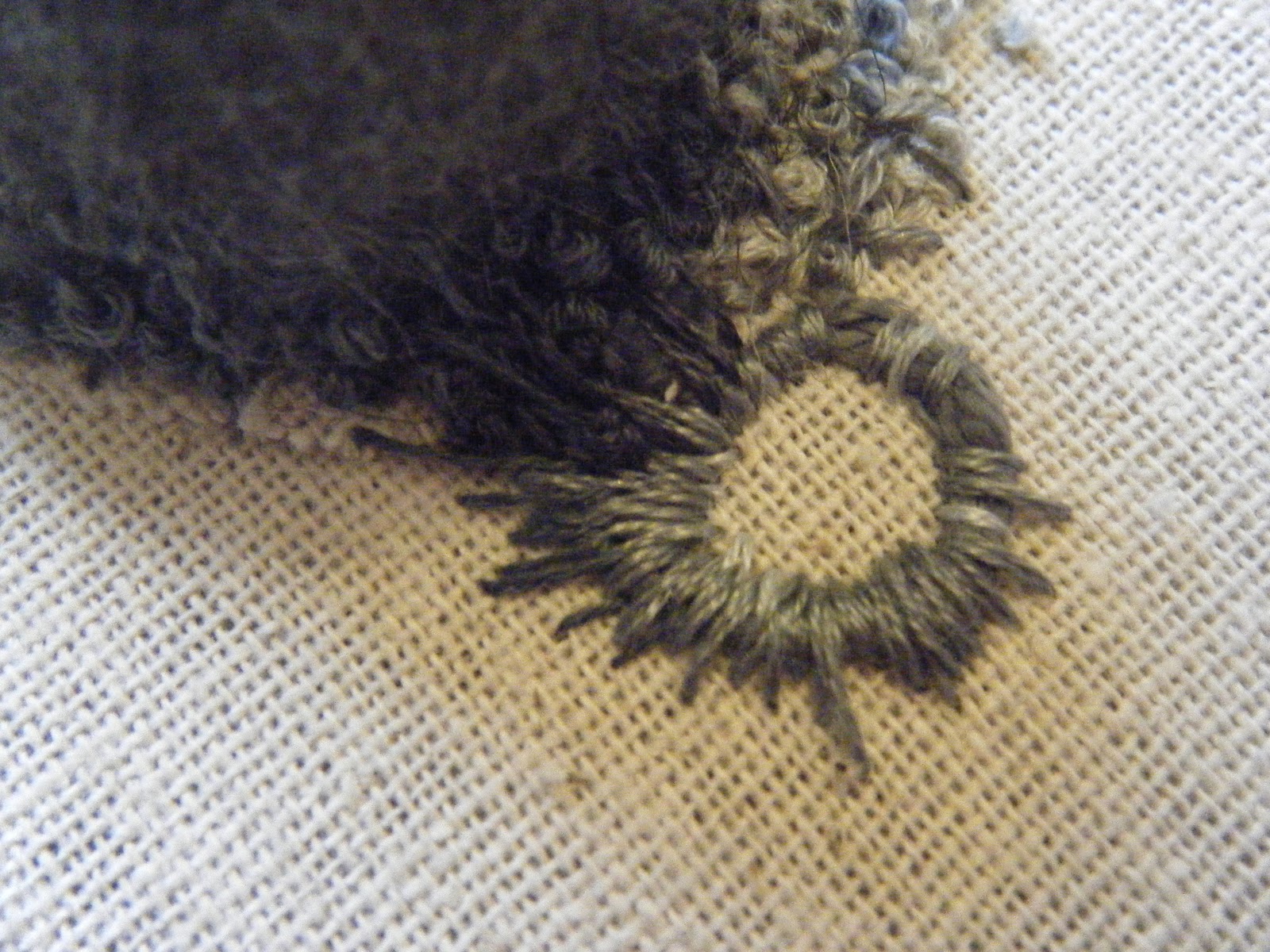
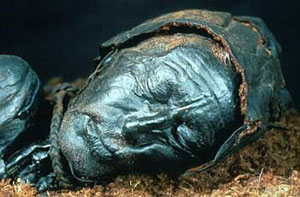
 This weeks creation (mum screamed when she saw it, it's not that freaky is it?!) is a needle felt face framed by a plethora of french knots, random stitches, silk shading and couching focusing on tone and texture. I'm not really sure what my inspiration for this was, other than a desire to practice my felt faces, except that a few days ago we studied this guy in biology:
and I think he might have nestled himself into a more gruesome part of my subconscious because I didn't see the link until someone else pointed it out.

TOP: Close-ups and process images of my
definitely-not-gruesome-I-hope felt face. I particularly proud
of the silk shading in the eyeballs
even though it isn't very clear in the
pictures
BOTTOM: (from wikipedia)The Tollund Man is the naturally mumified corpse 
 of a man who lived during the 4th century BC,
during the time period characterised in Scandinavia
as the Pre-Roman Iron Age.He was found in 1950
buried in a peat bog on the Jutland Peninsula in Denmark,
which preserved his body. 
Such a find is known as a bog body.The head and face
were so well-preserved that he was mistaken at the 
time of discovery for a recent murder victim. 

Monday, 21 November 2011

Men of the Land


Above(clockwise):Gary, Family Portrait
(Sheepish, Gary & Junior)&
Close up of Sheepish. Sheepish. 

Above: Sheepish
Below: Gabriel


A Spot of Inspiration

Jaume Plensa (http://jaumeplensa.com/)  at The Yorkshire Sculpture Park


 Above: See no evil, hear no evil, speak no evil.
I love the light (that almost feels like emotion) coming from inside the figures. Their presence in the space was awe inspiring. In a strange way it was like standing in a room with your emotions and thoughts looking down at you.
Below: The giant alibaster heads were more disquieting,
like sleeping giants. 
The lighting and cleane, whiteness of 
everything gave the faces a super human beauty.